Pakistan’s Information Ministry on Friday denied what the Afghan Islamic Emirate had announced regarding its targeting of camps allegedly belonging to militants in the border areas of Khyber Pakhtunkhwa and Balochistan provinces, describing those claims as “false as usual.”
In a statement published via its account dedicated to verifying news, the ministry said the Afghan Taliban regime claims, through its propaganda platforms and official statements, that it targeted certain sites attributed to the “ISIS-Khorasan” group in the border areas using primitive drones. It affirmed that these claims are devoid of truth.
The ministry went further, stressing that militant camps—including those of “ISIS” and more than twenty other groups—are in fact located inside the territory under the control of the Taliban regime, and are run and sponsored from there.
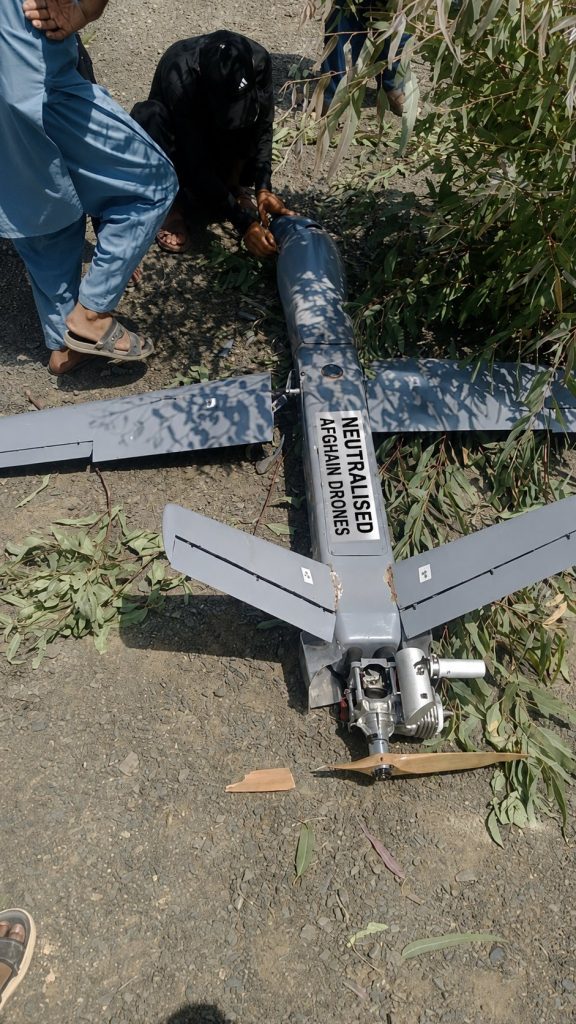
According to the statement, a primitive drone belonging to the Taliban regime breached Pakistani airspace near the Shinko area in Khyber province, but the Pakistan Air Force’s air defense system detected and immediately shot it down. The ministry published an image of the drone in question.
The ministry also accused the Taliban regime of habitually issuing such statements to cover up what it described as its sponsorship of terrorism waged against neighboring countries and the region, including the terrorism of “ISIS” and what Islamabad calls the “Khawarij sedition” and the “Hindustan sedition.” The Pakistani government uses the former term to refer to the banned “Pakistani Taliban” (Tehrik-i-Taliban Pakistan) and its affiliated groups, while it uses the latter to refer to groups it accuses India of sponsoring to carry out attacks on Pakistani territory.
Earlier that same day, the Afghan Taliban had announced the launch of “airstrikes” on what it described as militant hideouts in the provinces of Khyber Pakhtunkhwa and Balochistan, which border Afghanistan. This development comes more than a week after strikes carried out by Pakistan against militant hideouts on its border with Afghanistan, which Information Minister Attaullah Tarar said had killed 26 militants and came in response to a series of attacks targeting members of the Pakistani army and police.
Islamabad has repeatedly demanded that the Taliban administration dismantle militant safe havens on Afghan territory, particularly those linked to the “Pakistani Taliban,” affirming that its appeals have gone unanswered. The Afghan Taliban, for their part, deny these accusations and consider the phenomenon of extremism in Pakistan to be an internal problem that concerns Pakistan alone.
Pakistan had launched a military operation in February named “Wrath for the Truth” following gunfire from the Afghan side across the border. A Chinese mediation effort between the two countries—within whose framework talks were held in the city of Urumqi in April—led to a temporary calm that lasted until the strikes of 9 June.
For its part, Pakistan’s Foreign Ministry stresses that progress in relations with Afghanistan is contingent on credible counterterrorism guarantees from Kabul, foremost among them a pledge not to use its territory to launch attacks against Pakistan. Islamabad has also consistently raised its concerns about the use of Afghan territory for cross-border terrorism before international forums, chief among them the United Nations, where its ambassador, Asim Iftikhar Ahmad, earlier this month called on the Security Council for the Taliban authorities to take “verifiable and irreversible” measures against the armed groups operating from Afghan territory, expressing regret that this demand remains unmet.

اشترك لتصلك أبرز التغطيات والقصص الحصرية من فريق الأسطل مباشرةً إلى بريدك.